
From your first message to your safe return home — we handle everything, step by step.
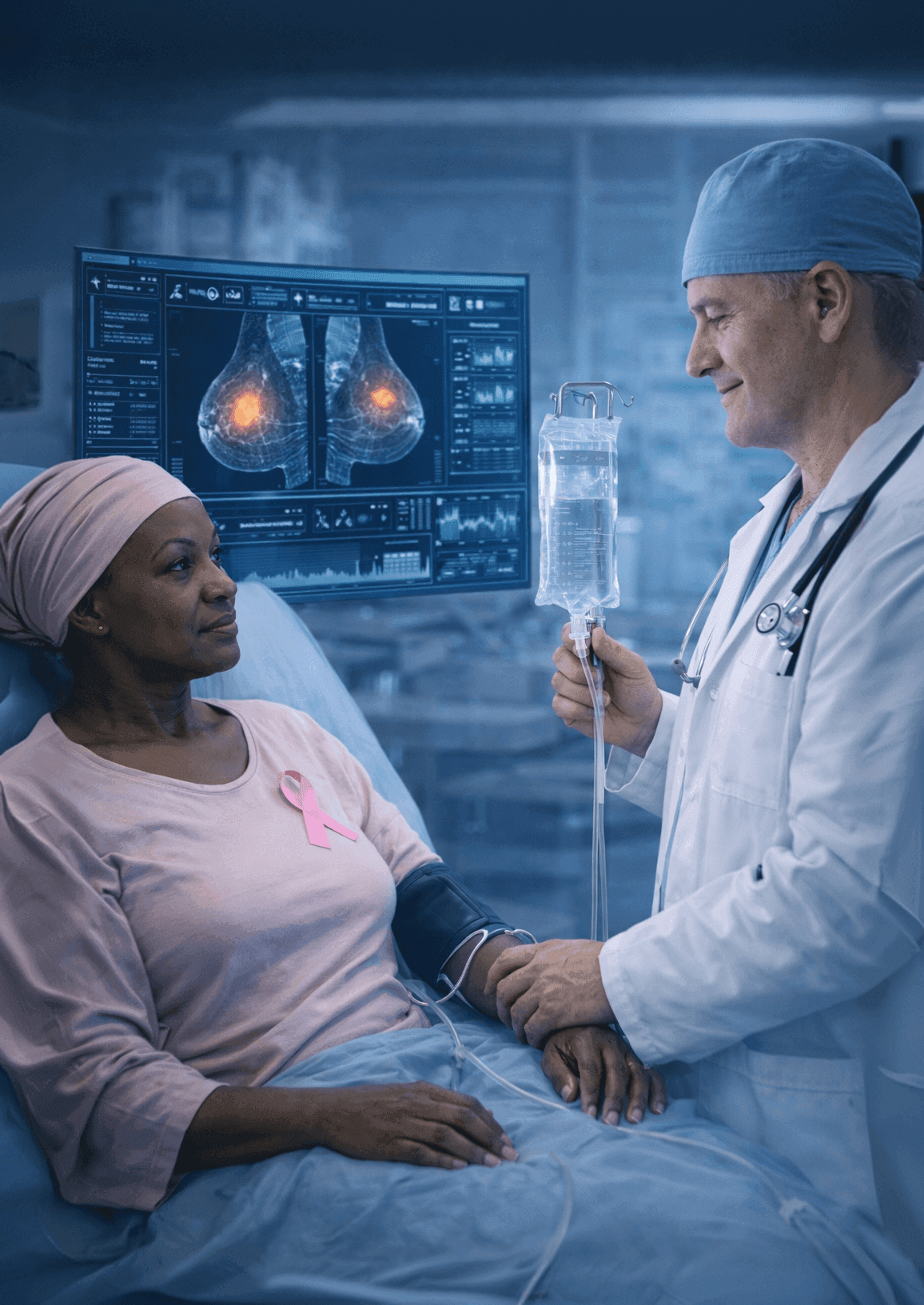
HealBridge connects international patients with leading breast cancer specialists and advanced breast clinics in Türkiye, providing comprehensive services for breast cancer diagnosis, treatment, and long-term care.
Breast cancer care requires a highly coordinated multidisciplinary approach. Through our network of partner hospitals, patients can access specialized teams including:
This collaborative approach ensures that every patient receives personalized treatment planning and coordinated care throughout their entire breast cancer journey.
Modern breast cancer treatment involves close collaboration between multiple medical specialties.
A typical multidisciplinary breast clinic team may include:
Additional patient support services may also include:
This integrated approach ensures that treatment plans address both the medical and emotional needs of patients.
Breast cancer occurs when abnormal cells in the breast grow and divide uncontrollably, forming a tumor.
Breast tumors can be:
Most breast cancers begin in the:
Early diagnosis plays a critical role in successful treatment outcomes.
Early breast cancer symptoms may be subtle and sometimes difficult to detect without screening.
Possible warning signs may include:
It is important to note that not all breast lumps are cancerous. Many breast lumps are benign conditions such as cysts or fibroadenomas.
However, any unusual breast change should be evaluated by a medical professional.
The exact cause of breast cancer is not fully understood, but several risk factors have been identified.
Common risk factors include:
Genetic testing and counseling may help identify individuals with increased risk.
Although rare, breast cancer can also occur in men.
Male breast cancer accounts for less than 1% of all breast cancer cases. Risk factors may include genetic predisposition, family history, and certain hormonal conditions.
Because awareness is lower among men, diagnosis may occur later than in women. Early medical evaluation is therefore important when symptoms appear.
Breast cancers are classified according to where they originate and their biological characteristics.
The most common types include:
Cancer that begins in the milk ducts. This accounts for approximately 80–85% of breast cancer cases.
Cancer that begins in the milk-producing glands (lobules), representing around 10–15% of cases.
Less common forms include:
Breast cancers are also classified based on hormone receptor status:
Understanding the tumor type helps physicians select the most effective treatment strategy.
Early detection significantly improves outcomes in breast cancer treatment.
Diagnostic evaluation may include several imaging techniques.
Mammography is the primary screening tool used to detect early breast cancer.
Modern imaging methods may include:
Ultrasound is often used to further evaluate suspicious findings or examine dense breast tissue.
If imaging tests identify suspicious areas, a biopsy may be performed to obtain a tissue sample for pathological examination.
Biopsies are often performed using image guidance to ensure accuracy.
Breast cancer staging describes how far the cancer has progressed and whether it has spread beyond the breast.
Stages range from Stage 0 to Stage IV.
Tumors are also graded based on how abnormal the cancer cells appear and how quickly they are likely to grow.
Staging and grading are critical for determining the most appropriate treatment plan.
Modern breast cancer treatment involves a combination of therapies tailored to the patient's condition.
Common treatment options include:
Surgery is often the first step in treatment.
Procedures may include:
Whenever possible, breast-conserving approaches are preferred to preserve natural breast appearance.
Immediate breast reconstruction may be performed at the same time as mastectomy to restore the breast shape.
Chemotherapy uses medications to destroy cancer cells and may be used before or after surgery.
Radiotherapy uses high-energy radiation to eliminate remaining cancer cells and reduce recurrence risk.
Hormone therapy blocks hormones that stimulate cancer growth in ER-positive or PR-positive tumors.
Targeted therapies attack specific cancer cell pathways while minimizing damage to healthy cells.
Immunotherapy stimulates the body's immune system to fight cancer and may be used in selected advanced breast cancer cases.
Some modern breast surgery techniques aim to improve both medical outcomes and cosmetic results.
Examples may include:
These approaches help reduce visible scarring and support better psychological recovery for patients.
Thanks to advances in early detection and modern treatment, survival rates for breast cancer have improved significantly.
According to global health data, five-year survival rates exceed 90% in many early-stage cases when breast cancer is diagnosed and treated early.
Outcomes depend on factors such as:
Early screening and multidisciplinary treatment remain the most effective strategies for improving outcomes.
HealBridge connects patients with specialized breast clinics and oncology centers in Türkiye that provide advanced breast cancer care through multidisciplinary treatment programs.
Patients benefit from:
Our goal is to help international patients access advanced breast cancer treatment in Türkiye with the highest standards of medical care and compassionate patient support.