
Expert insights on medical conditions, treatments, and health tips.
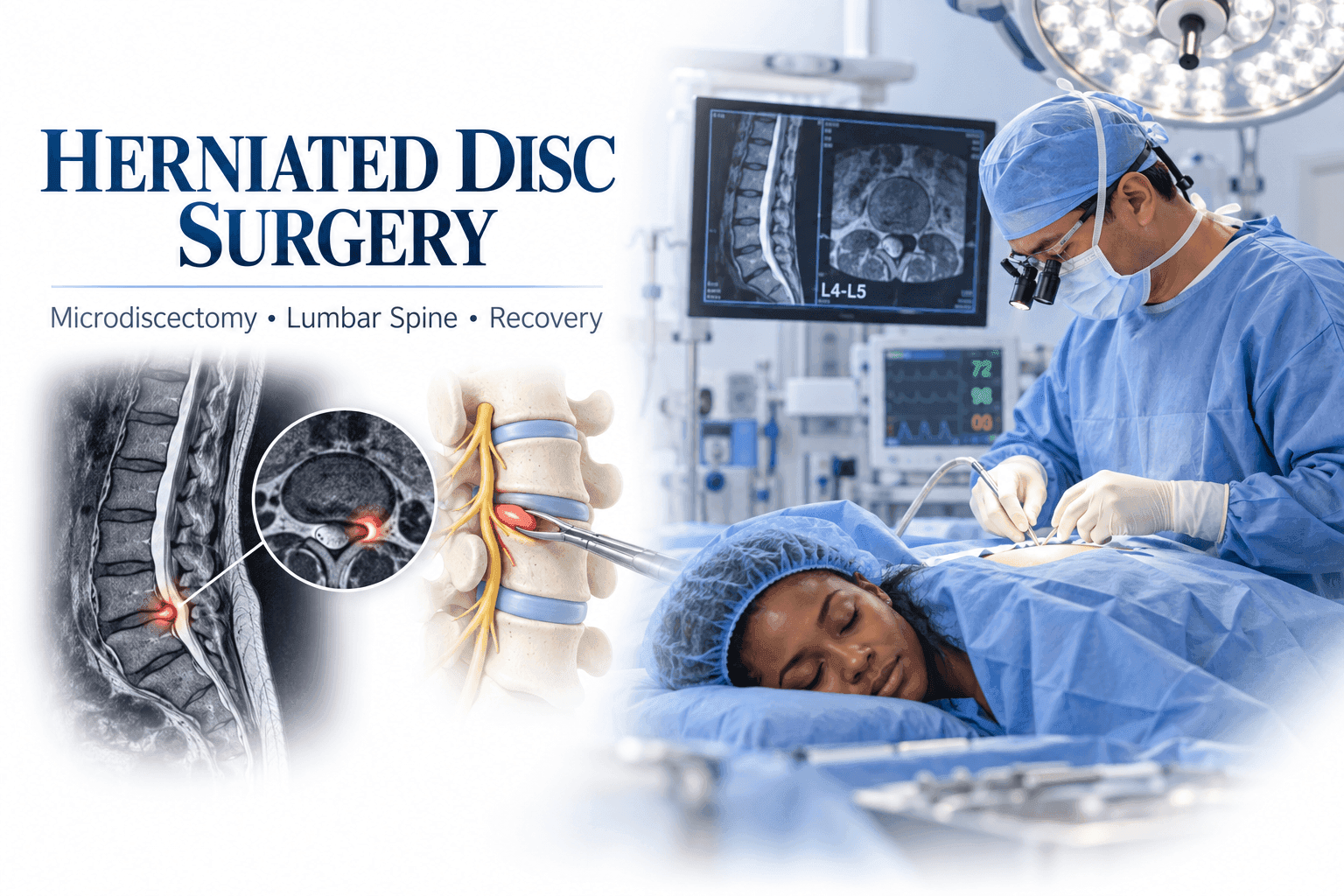
A herniated disc can cause anything from mild back discomfort to severe pain travelling down the leg or arm, numbness, tingling and muscle weakness.
If an MRI shows a herniated or "slipped" disc, one of the first questions many patients ask is: do I need surgery?
In many cases, the answer is no. Most herniated discs are initially treated without surgery. However, when symptoms persist despite appropriate treatment or when significant nerve compression causes neurological problems, surgery may become an option.
Understanding when surgery is — and is not — necessary is therefore an important part of making an informed treatment decision.
The spine consists of vertebrae separated by intervertebral discs. These discs act as cushions and help the spine move.
Each disc has a softer central portion surrounded by a tougher outer layer. A herniated disc occurs when disc material protrudes through the outer layer. Problems can occur if this material compresses or irritates a nearby nerve.
Herniated discs are most common in the lower back, known as the lumbar spine, but can also occur in the neck or cervical spine.
Symptoms vary depending on the location of the disc and which nerve is affected. They can include:
Some people have a herniated disc visible on MRI without significant symptoms. For this reason, treatment should not be based on the MRI image alone.
Many patients improve without an operation.
Depending on the individual diagnosis and medical history, conservative treatment may include:
Symptoms can improve as inflammation settles and the body adapts or the herniated material changes over time. The appropriate treatment depends on the patient's symptoms and clinical findings.
Surgery may be considered when there is a clear relationship between the patient's symptoms and nerve compression seen on imaging, particularly when:
The decision should always be individualised.
When is it an emergency? Certain symptoms require urgent medical assessment. These include new loss of bladder or bowel control, numbness around the genital or saddle area, or rapidly progressing weakness. These symptoms can indicate serious nerve compression and should not wait for a routine consultation.
Microdiscectomy is one of the most commonly performed operations for selected lumbar disc herniations.
The objective is straightforward: remove the disc material compressing the affected nerve while preserving as much normal anatomy as possible.
The surgeon accesses the affected area and removes the portion of disc responsible for nerve compression. Microdiscectomy is particularly associated with treatment of persistent sciatica caused by lumbar disc herniation.
Endoscopic spine surgery uses a small camera and specialised instruments to access the affected area. For carefully selected patients, endoscopic techniques may reduce disruption of surrounding tissues.
However, not every herniated disc is suitable for endoscopic treatment. The position of the disc, anatomy of the spine, degree of nerve compression and other spinal problems all influence whether the technique is appropriate.
Usually, a straightforward herniated disc does not automatically require spinal fusion. Fusion may be considered when additional problems exist, such as significant instability or certain structural conditions.
If fusion has been recommended for a disc problem, it is reasonable to ask your surgeon why it is necessary. A second specialist opinion may also help clarify whether fusion or a less extensive procedure is appropriate.
Minimally invasive spine surgery refers to techniques designed to perform certain procedures while reducing disruption to muscles and surrounding tissues. Potential benefits in appropriately selected patients can include smaller incisions and earlier mobilisation.
However, the goal of surgery is not simply to create the smallest possible incision. The priority is to adequately treat the nerve compression while performing the safest and most appropriate operation for the individual condition.
The duration depends on the procedure, location and complexity of the condition. A relatively straightforward microdiscectomy is very different from an operation involving multiple spinal levels or additional stabilisation.
Your surgeon should explain the expected duration and hospital stay after reviewing your imaging.
Recovery varies between individuals.
First days: Patients are often encouraged to begin walking relatively early, depending on their condition and surgeon's advice.
First few weeks: Activity is gradually increased. Heavy lifting and strenuous exercise are generally restricted during the early recovery period.
Returning to work: This depends on the patient's occupation. Someone working at a desk may return sooner than a person whose job involves significant physical activity.
Exercise: Exercise should be resumed gradually according to the surgeon or physiotherapist's recommendations.
Improvement in leg pain can occur relatively quickly in some patients, while numbness or weakness caused by previous nerve compression may take longer to recover.
Disc herniation can recur after surgery in some patients. Surgery removes the portion of disc causing the nerve compression but does not create an entirely new disc.
Patients should discuss recurrence, lifestyle, rehabilitation and longer-term spine care with their medical team.
All surgery carries potential risks. Depending on the operation and individual patient, possible complications may include:
The likelihood and relevance of individual risks should be discussed with the treating surgeon.
International patients considering herniated disc surgery in Türkiye should evaluate more than the cost of the procedure.
Important considerations include:
Healbridge helps international patients connect with selected specialists and hospitals in Türkiye and coordinates the healthcare journey.
In many cases, yes. The initial evaluation can often begin remotely.
Useful documents include:
Providing the actual MRI images can give the specialist more information than the written report alone. Additional examinations or imaging may still be required.
If you have been advised to undergo spinal surgery, particularly a more extensive procedure, another specialist opinion can help answer important questions:
The purpose of a second opinion is not necessarily to find a different answer. Sometimes it confirms the original recommendation and gives the patient greater confidence in the treatment decision.
Can a herniated disc heal without surgery? Many patients improve without surgery. The appropriate approach depends on symptoms, neurological findings and imaging.
When does a slipped disc need surgery? Surgery may be considered when persistent nerve compression causes severe pain or neurological symptoms despite appropriate non-surgical treatment.
Is microdiscectomy major surgery? Microdiscectomy is a spinal surgical procedure, although it is less extensive than many forms of spinal fusion. Individual risks and recovery should be discussed with the surgeon.
Is minimally invasive surgery always better? No. Minimally invasive techniques can be beneficial for selected patients, but the most appropriate procedure depends on the individual spinal problem.
Can I send my MRI for review before travelling to Türkiye? For many cases, an initial specialist assessment can begin using existing MRI images, medical reports and history. Further evaluation may still be necessary.
Before making your decision, you can begin by understanding your options.
Send Healbridge your MRI images, reports and medical history. We can help coordinate an appropriate specialist review before you decide whether travelling to Türkiye for treatment is right for you.
Medical disclaimer: This content is provided for general educational purposes and does not replace individual diagnosis or medical advice. Treatment suitability, risks and recovery must be assessed by an appropriate healthcare professional.